Complete Guide to GPA and CGPA in Pakistan (2026)

If you are a university student in Pakistan, you have almost certainly heard the terms GPA and CGPA mentioned constantly — in conversations with seniors, printed on your semester results, referenced in job advertisements, and discussed in scholarship eligibility requirements. Yet despite how central these numbers are to your academic and professional life, a surprisingly large proportion of Pakistani students reach their final year without truly understanding how these numbers are calculated, what they mean in practice, and what strategic decisions they can make to influence them.
This is the most comprehensive, authoritative guide to GPA and CGPA ever written specifically for Pakistani university students. It covers the historical background of how Pakistan adopted the GPA system, the precise mathematical formulas used to calculate both GPA and CGPA, the grading policies at all major Pakistani universities including UAF, FAST, NUST, LUMS, and Punjab University, the career and graduate-school implications of different CGPA ranges, the most common and costly mistakes students make, and the highest-impact strategies for improvement. Whether you are starting your first semester or preparing to graduate, this guide will give you a complete, actionable understanding of the academic measurement system that defines your university career.
Why Pakistan Adopted the GPA System — The Historical Background
For most of the 20th century, Pakistani universities operated on an annual examination system inherited from the British colonial model. Students would study for an entire academic year and then sit comprehensive examinations, receiving a final percentage score. A student who scored 65% overall was considered to have passed with a second division; 75% or above earned a first division; and 80%+ might earn a distinction. This system was familiar and simple, but it had several serious structural limitations that ultimately led to its replacement.
The percentage system evaluated students on a single annual high-stakes examination, meaning an entire year of learning was assessed in a few hours of testing. It rewarded those who excelled at examination performance specifically — particularly the ability to memorise and reproduce large amounts of material under time pressure — rather than sustained, consistent academic engagement. It provided minimal granular information about student performance across different subjects or over time. And it made international comparison and recognition difficult, since each country used different scales and designations.
In 2002, the Higher Education Commission (HEC) was established and immediately began a comprehensive reform of Pakistan's higher education landscape. A central pillar of this reform was the adoption of the semester-based credit-hour system with a 4.0 GPA scale. The rationale was clear: the GPA system aligned Pakistani degrees with internationally recognised standards, making it easier for Pakistani graduates to apply to foreign universities and employers; it introduced more frequent, distributed assessment through the semester structure; and it provided a more nuanced, comprehensive measure of academic performance through the credit-hour weighting mechanism.
By the mid-2000s, most public and private universities had transitioned to the semester system. By the early 2010s, it was effectively universal across HEC-recognised degree-awarding institutions. Today, when you receive your results each semester, your GPA and running CGPA are the primary academic metrics of record — the numbers that will define your academic credentials for the rest of your professional life.
What is GPA? A Precise, Complete Definition
GPA stands for Grade Point Average. It is a numerical value on a 0.0 to 4.0 scale that represents your average academic performance across all the courses you completed in a specific semester. The 4.0 represents the highest possible achievement — equivalent to earning the top grade (A or A+) in every course. The word "average" in the name is important, but it specifically means a weighted average, not a simple one.
The weighting in GPA is determined by credit hours. Every course in your university programme is assigned a number of credit hours — typically between 1 and 4 — reflecting the academic workload and importance of that course. A 4-credit course like Engineering Mathematics contributes four times as much to your GPA as a 1-credit lab course. When calculating your GPA, you first multiply each course's grade points by its credit hours to get "quality points," then sum all quality points and divide by total credit hours.
This weighting is pedagogically sound: it ensures your GPA reflects the genuine academic complexity and time investment of your courses. A student who earns A grades in difficult 4-credit core courses will have a higher GPA than one who earns As only in easy 1-credit electives, even if both students passed the same number of subjects. Understanding this weighted structure is the single most important foundation for all GPA-related strategy.
What is CGPA? The Cumulative Record
CGPA stands for Cumulative Grade Point Average. The key word is "cumulative" — your CGPA is the ongoing, running average of your academic performance across every semester you have completed since enrolling in your degree programme. Where GPA is a snapshot of a single semester, CGPA is the complete picture of your academic journey from Day 1 to the current moment.
Your CGPA is recalculated and updated at the end of every semester to incorporate your latest results. When you graduate, your final CGPA — computed from every course you took across all semesters of your degree — is printed on your degree certificate and official transcript. It is the number that employers, graduate schools, scholarship committees, and government agencies will see and use when evaluating your academic credentials.
CGPA has one critical mathematical property: it becomes progressively more resistant to change as you accumulate credit hours. In your first semester, your CGPA equals your Semester 1 GPA — one semester of data. By your seventh or eighth semester, your CGPA represents seven previous semesters of weighted data, so your current semester's results have proportionally much less impact on the cumulative total. This has profound strategic implications: the academic habits and decisions you make in your first year have a far larger effect on your final graduation CGPA than the same habits and decisions made in your final year.
The GPA Formula — Explained Step by Step
The GPA calculation follows a consistent four-step process. Mastering this process means you can calculate your own GPA at any time, verify your official results, and predict how different grade outcomes will affect your standing before results are released.
Look up grade points for each letter grade
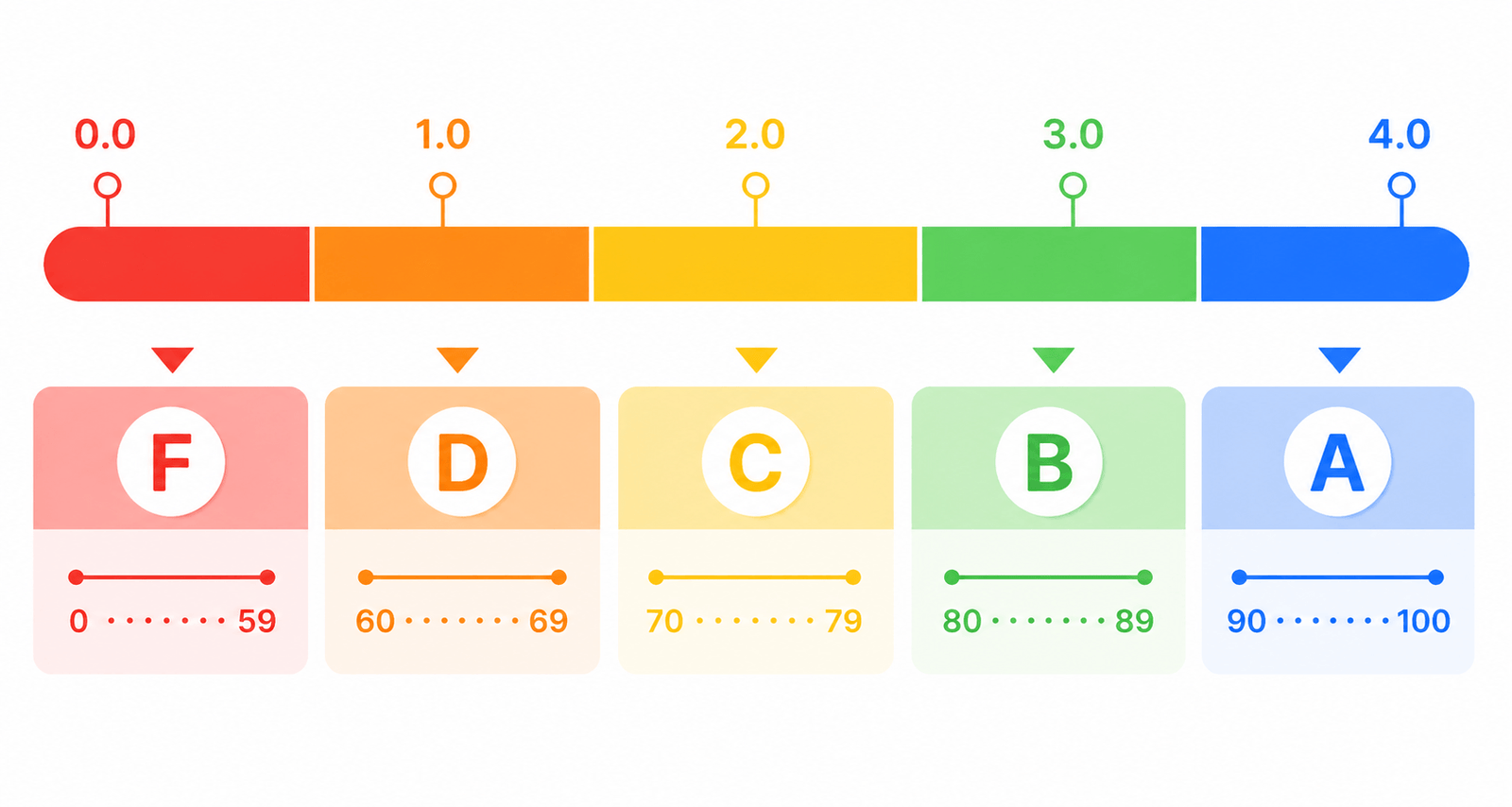
Each letter grade (A, B+, C, etc.) corresponds to a specific grade point value on the 4.0 scale. Consult your university's official grading table — or use the standard HEC table below.
Calculate quality points for every course
Quality Points = Grade Points × Credit Hours. Do this separately for every course including labs. This step accounts for the weighting — a C in a 4-credit course damages your GPA more than a C in a 1-credit course.
Sum all quality points
Add up all quality points across every course in the semester. This gives you the total quality points for the semester.
Divide by total credit hours
GPA = Total Quality Points ÷ Total Credit Hours. Round to two decimal places. That is your semester GPA.
Standard Pakistan Grading Scale
| Letter Grade | Grade Points | Percentage Range | Classification |
|---|---|---|---|
| A+ / A | 4.0 | 85–100% | Outstanding / Excellent |
| A- | 3.7 | 80–84% | Very Good |
| B+ | 3.3 | 75–79% | Good |
| B | 3.0 | 70–74% | Above Average |
| B- | 2.7 | 65–69% | Average |
| C+ | 2.3 | 60–64% | Satisfactory |
| C | 2.0 | 55–59% | Acceptable |
| C- | 1.7 | 50–54% | Marginal Pass |
| D | 1.0 | 45–49% | Passing |
| F | 0.0 | Below 45% | Fail |
Full Worked Example 1 — BS Computer Science, Semester 2
| Course | Grade | Grade Points | Credit Hours | Quality Points |
|---|---|---|---|---|
| Data Structures | A- | 3.7 | 3 | 11.1 |
| Digital Logic Design | B+ | 3.3 | 3 | 9.9 |
| Object-Oriented Programming | A | 4.0 | 3 | 12.0 |
| OOP Lab | A | 4.0 | 1 | 4.0 |
| Communication Skills | B | 3.0 | 2 | 6.0 |
| Islamic Studies / Ethics | A+ | 4.0 | 2 | 8.0 |
| TOTALS | 14 | 51.0 |
GPA = 51.0 ÷ 14 = 3.64 — an excellent A- average. This is exactly what our free GPA Calculator computes instantly when you enter the same data.
Full Worked Example 2 — A Difficult Semester
| Course | Grade | Grade Points | Credit Hours | Quality Points |
|---|---|---|---|---|
| Advanced Calculus | C+ | 2.3 | 3 | 6.9 |
| Electromagnetics | C | 2.0 | 3 | 6.0 |
| Programming (C++) | B+ | 3.3 | 3 | 9.9 |
| Technical Writing | A- | 3.7 | 2 | 7.4 |
| Pakistan Studies | B | 3.0 | 2 | 6.0 |
| TOTALS | 13 | 36.2 |
GPA = 36.2 ÷ 13 = 2.78 — a B- average with clear room for improvement. Notice how two high-credit C/C+ grades in Calculus and Electromagnetics dragged the entire semester GPA down below 3.0, despite the student earning good grades in other subjects.
The CGPA Formula — Multi-Semester Calculation
CGPA applies the same weighted average logic across all completed semesters. Rather than weighting individual courses by their credit hours, you weight entire semesters by their total credit hour loads:
CGPA = Σ(Semester GPA × Semester Credits) ÷ Σ(All Credits Completed)
5-Semester CGPA Calculation Example
| Semester | GPA | Credits | Weighted Pts | Running CGPA | Change |
|---|---|---|---|---|---|
| Semester 1 | 3.64 | 14 | 50.96 | 3.64 | — |
| Semester 2 | 2.78 | 13 | 36.14 | 3.23 | ▼ −0.41 |
| Semester 3 | 3.50 | 16 | 56.00 | 3.29 | ▲ +0.06 |
| Semester 4 | 3.75 | 17 | 63.75 | 3.44 | ▲ +0.15 |
| Semester 5 | 3.80 | 18 | 68.40 | 3.54 | ▲ +0.10 |
| Total | 78 | 275.25 | 3.54 |
CGPA = 275.25 ÷ 78 = 3.53. Despite three consecutive strong semesters after the Semester 2 drop, it took until Semester 5 for the CGPA to recover to 3.54 — still below the original 3.64 starting point after six semesters. This data illustrates vividly why early-semester performance has such outsized, lasting impact on cumulative standing.
How to Read Your University Transcript
Your semester transcript shows two critical numbers: the semester GPA for that specific semester, and the cumulative CGPA up to and including that semester. Understanding what each number tells you and how they relate is important for correctly assessing your academic standing at any point in your degree.
The semester GPA tells you how you performed in that specific period. If your semester GPA is higher than your existing CGPA, your overall standing improved. If it is lower, your standing declined — even if the semester GPA itself seems good in isolation. The CGPA tells you your aggregate academic standing across your entire degree to that point. This is the number most relevant to employment applications, scholarship eligibility, and graduate school admissions.
Some Pakistani universities also show a "semester credit hours attempted," "semester credit hours earned," and "cumulative quality points" section on transcripts. Your CGPA is always: cumulative quality points ÷ cumulative credit hours earned. If the numbers on your transcript do not match your manual calculation, check whether your university excludes certain course types (audit courses, withdrawal courses, or pass/fail non-credit courses) from the GPA calculation.
University-Specific Grading Policies Across Pakistan
While the 4.0 GPA scale is standard, Pakistani universities vary in their grade boundaries, minimum passing marks, Dean's List thresholds, and CGPA graduation requirements. Students at different institutions are not competing on identical terms, which is something to understand when comparing GPAs across institutions.
NUST (National University of Sciences and Technology)
NUST is Pakistan's highest-ranked university by most international measures, particularly in engineering, computer science, and business. NUST uses the standard 4.0 scale with absolute (marks-based) grading. Minimum passing mark: 50%. Minimum graduation CGPA: 2.0. Academic honours: Rector's Honor Roll requires CGPA 3.80+ and semester GPA 3.80+; Dean's Honor Roll requires CGPA 3.50+ with no F grades that semester. NUST students should note that the competitive academic environment and strong cohort performance means that grade boundaries can feel demanding even on the absolute scale.
LUMS (Lahore University of Management Sciences)
LUMS is Pakistan's most prestigious private university. LUMS uses relative (curve-based) grading in many courses, particularly at the business school. Under relative grading, your letter grade depends partly on class performance distribution — a 75% raw score might earn an A- in one cohort and a B in a higher-performing cohort. LUMS requires minimum CGPA of 2.0 for most programmes and 2.5 for BBA/MBA at the Suleman Dawood School of Business. LUMS students cannot rely on standard percentage-to-grade conversion tables and should factor in class context when estimating grades.
FAST-NUCES (National University of Computer and Emerging Sciences)
FAST uses the 4.0 scale with two key differences: minimum passing mark is 40% (vs HEC's 45–50%), and FAST includes a D+ grade worth 1.3 points not present at most other institutions. FAST's Dean's List requires semester GPA 3.80+ with a full course load and no F grades. Course repeat policy at FAST replaces the old grade with the new in CGPA calculations. FAST is Pakistan's premier technology institution with five campuses.
University of Agriculture Faisalabad (UAF)
UAF follows the HEC standard 4.0 scale with 50% minimum passing mark. UAF programmes are lab-intensive — lab courses carry 1 credit hour each and are graded independently from theory courses, providing additional GPA opportunities through practical performance. A typical UAF semester runs 16–21 credit hours. A BSc Hons 4-year programme requires approximately 130–140 total credit hours. Honours at graduation: Distinction at CGPA 3.5+, High Distinction at CGPA 3.7+.
University of the Punjab (PU)
PU, established in 1882, is Pakistan's oldest and one of its largest universities. PU follows the HEC standard 4.0 scale with 50% minimum passing mark and 2.0 minimum graduation CGPA. PU's transition from annual examinations to the semester system is largely complete across most faculties, though some departments may still use hybrid models for specific programmes.
COMSATS University Islamabad (CUI)
COMSATS operates multiple campuses and uses absolute HEC-standard grading. Strong in engineering and CS. Minimum pass: 50%. Minimum graduation CGPA: 2.0. Dean's List: CGPA 3.50+. COMSATS's absolute grading system makes grade calculation straightforward — your mark against the fixed scale determines your grade without class-performance adjustment.
IBA Karachi
Pakistan's most prestigious business school uses relative grading similar to LUMS and holds a higher minimum graduation CGPA of 2.5 — reflecting consistently higher academic standards. Students at IBA should understand that their grades are distributed relative to cohort performance, making direct percentage-to-GPA conversions unreliable.
What CGPA Range Is "Good" for Different Goals?

3.7 to 4.0 — Excellence Range
This range puts you on Dean's Honor Rolls and qualifies you for the most competitive opportunities in Pakistan: top multinational management trainee programmes, international scholarships (Fulbright, Chevening, DAAD, Erasmus+, Australian Awards), admission to elite MS/PhD programmes at Pakistan's top universities and internationally, and institutional merit awards. Students in this range are genuinely competing at the level where CGPA alone opens significant doors.
3.5 to 3.69 — High Merit Range
Considered excellent by virtually all standards in Pakistan. Competitive for most prestigious private sector graduate programmes, eligible for many merit-based scholarships, strong MS admissions profile at Pakistan's leading universities. International universities in the 50th–100th global ranking range typically view this CGPA very positively for graduate admissions.
3.0 to 3.49 — Good Standing Range
The informal industry benchmark for competitive private-sector hiring. Most major Pakistani corporations — HBL, MCB, Engro, PTCL, and comparable employers — use 3.0 as a standard HR screening threshold. Students in this range qualify for most MS programme admissions, are competitive for HEC-funded scholarships, and have access to the full range of mainstream career opportunities in Pakistan's formal economy.
2.5 to 2.99 — Satisfactory Range
Meets graduation requirements comfortably. Basic job eligibility criteria are met. Some MS programmes, particularly less competitive ones or part-time programmes, will accept applicants in this range. However, students here may find themselves screened out at the initial filter stage at competitive employers. Supplementing with strong internship experience, technical certifications, and portfolio work helps bridge the gap that CGPA alone does not cover.
2.0 to 2.49 — Minimum Pass Range
Eligible to graduate under HEC minimum requirements. Significantly restricted career opportunities in the formal job market. HR screening filters at most competitive employers eliminate candidates below 2.5. This range warrants serious effort to improve through course repeats, intensive study discipline, and where possible, seeking academic support resources from your university.
Below 2.0 — Academic Probation
Most Pakistani universities place students in this range on academic probation, typically giving one to two semesters to improve above 2.0. Failure to recover within the allowed period may result in academic dismissal. If you are approaching this threshold, seek immediate guidance from your academic advisor — institutional support mechanisms exist but require you to engage with them proactively.
CGPA and Career in Pakistan — Industry by Industry
The role of CGPA in Pakistani hiring varies meaningfully by industry. Understanding the specific norms in your target sector allows you to calibrate your academic goals appropriately rather than chasing a single universal number.
Multinational Consumer Goods (FMCG)
Companies like Unilever Pakistan, Procter and Gamble Pakistan, Reckitt, and similar multinationals are among Pakistan's most sought-after graduate employers. Their Management Trainee Programmes (MTPs) typically have CGPA thresholds of 3.0 to 3.5 at initial screening. The exact threshold varies year to year and by campus, but applicants below 3.0 rarely clear automated screening. Among the most competitive MTPs — P&G's Future Leaders Programme, Unilever's UFLP — an effective preference for 3.5 and above is consistently reported by successful candidates.
Banking and Financial Services
Pakistan's banking sector (HBL, MCB, UBL, Allied Bank, Habib Metro, Meezan Bank, Standard Chartered Pakistan, Bank Alfalah) typically requires 2.5 to 3.0 CGPA for entry-level positions. Management Associate programmes at top banks generally look for 3.0 to 3.5. Islamic banking institutions have broadly similar standards. Investment banking and private equity roles, which are fewer in number, typically require 3.5 and above from target universities.
Technology and Software Industry
Pakistan's technology sector has grown significantly and includes globally competitive firms like Systems Limited, NetSol, Arbisoft, 10Pearls, Contour Software, and many others. This sector is more flexible on CGPA than most other industries — technical portfolio work, open-source contributions, internship experience, and competitive programming achievements can partially offset a lower CGPA. Graduate programmes at larger technology firms still typically set 2.8 to 3.0 as a minimum. For highly competitive tech companies including startups seeking exceptional engineers, CGPA is often a secondary consideration after demonstrated technical ability.
Consulting and Professional Services
Management consulting firms operating in Pakistan (McKinsey, BCG, Deloitte, KPMG, A.T. Kearney) are among the most CGPA-conscious employers in the country. A CGPA below 3.5 from a non-target university, or below 3.3 from a target university, is likely to face significant hurdles at these employers. The case interview process is the primary differentiator, but CGPA serves as an initial filter that determines who gets the chance to interview.
Government Service and Civil Examinations
CSS and PMS eligibility is based on degree classification rather than a specific CGPA number. Typically, a minimum second-class degree is required, corresponding to CGPA above 2.0. CGPA matters less in this pathway than in private sector hiring, since selection is primarily based on written examination performance and interview scores. However, CGPA and academic credentials do appear on application forms and may influence assessors at the interview stage, particularly when comparing candidates of similar examination performance.
Academic and Research Careers
For students aiming at academic careers — university lectureship, research positions, PhD programmes — CGPA is very important. Most Pakistani universities require a minimum 3.0 CGPA for MS admission, and competitive programmes at NUST, LUMS, and QAU typically admit students with 3.3 and above. For HEC Indigenous PhD Scholarships, a minimum MS CGPA of 3.0 is required. For international research positions and PhD programmes, a 3.5+ is the competitive range at quality institutions.
Converting GPA to Percentage — The Complete Guide
Despite Pakistan's transition to the GPA system at universities, the percentage format remains deeply embedded in government, administrative, and many employer contexts. The standard conversion formula is:
Percentage = (CGPA ÷ 4.0) × 100 OR Percentage = CGPA × 25
| CGPA | Percentage Equivalent | Letter Grade | Classification |
|---|---|---|---|
| 4.0 | 100% | A+/A | Outstanding |
| 3.7 | 92.5% | A- | Excellent |
| 3.5 | 87.5% | A-/B+ | Very Good |
| 3.3 | 82.5% | B+ | Good |
| 3.0 | 75.0% | B | Above Average |
| 2.7 | 67.5% | B- | Average |
| 2.5 | 62.5% | C+ | Satisfactory |
| 2.0 | 50.0% | C | Pass |
Use our free GPA to Percentage Converter for instant calculations, or the Percentage to GPA Converter for the reverse. Remember that this conversion is an approximation — always use your actual CGPA from your official transcript when precision matters.
The Mathematics of CGPA Recovery — Realistic Expectations
Understanding how much CGPA improvement is mathematically achievable given your current standing and remaining credits is essential for realistic goal-setting. Students often overestimate their ability to recover a low CGPA by performing well in final years, and this misconception leads to both false comfort early in the degree and unnecessary despair later.
The maximum achievable final CGPA formula: if you have completed C credits with a current CGPA of G, and R credits remain in your programme, your maximum final CGPA (assuming a perfect 4.0 in all remaining semesters) is:
Max CGPA = (G × C + 4.0 × R) ÷ (C + R)
| Current Situation | Current CGPA | Credits Done | Credits Left | Max Achievable |
|---|---|---|---|---|
| Strong early intervention | 2.5 | 30 | 100 | 3.60 |
| Mid-programme action | 2.5 | 65 | 65 | 3.25 |
| Late programme action | 2.5 | 100 | 30 | 2.85 |
| Early intervention (3.0 start) | 3.0 | 30 | 100 | 3.77 |
| Mid-programme (3.0 start) | 3.0 | 65 | 65 | 3.50 |
These maximums assume a perfect 4.0 in every remaining semester. Realistic recovery scenarios with achievable 3.5–3.8 semester GPAs produce final CGPAs 0.2–0.4 points below these maximums. The conclusion is consistent across all scenarios: start acting early, because every semester of delay reduces both the magnitude and the achievability of CGPA improvement.
10 High-Impact Strategies for GPA Maximisation
Strategy 1: The Credit-Hour Prioritisation System
At the start of every semester, list your courses sorted from highest to lowest credit hours. This list is your academic priority ranking. Your highest-credit courses — the 3 and 4-credit subjects — should receive the most study time, the most careful assignment effort, and the most focused exam preparation. When you have limited time and must choose which subject to work on, always go to the highest-credit course where you are weakest. The quality point mathematics demands this: improving one 4-credit course by one letter grade generates four times the GPA benefit of the same improvement in a 1-credit course.
Strategy 2: Lock In Continuous Assessment Marks
Pakistani university assessment structures allocate 25–35% of each course's grade to quizzes, assignments, and class participation. This is the most controllable portion of your grade. Unlike final exams, where performance is variable and high-stakes, continuous assessment happens throughout the semester in lower-stress conditions where consistent effort reliably produces consistent marks. Make a personal rule: submit every assignment before the deadline, prepare for every quiz, never miss a graded class activity. Students who earn 85% on continuous assessment enter every final exam with a significant buffer — they can afford to underperform slightly on the final and still maintain strong grades.
Strategy 3: Strategic Course Repetition
Most Pakistani universities allow retaking courses in which you received low grades, with the new grade replacing the old in CGPA calculations. This is one of the most underused and highest-return CGPA improvement mechanisms available. The optimal target for course repetition is a high-credit course (3 or 4 credits) where you received a D or C grade. Improving a 3-credit D (1.0) to a B+ (3.3) adds 6.9 additional quality points — equivalent in GPA impact to earning an A grade in a completely separate 2-credit course. The best time to repeat a course is the immediately following semester, while the material is fresh in memory.
Strategy 4: Attend Every Lecture
Pakistani universities enforce 75–80% attendance requirements for a reason that goes beyond bureaucratic compliance. Students who attend regularly understand material incrementally rather than struggling to catch up, are present for announced quizzes and graded activities that cannot be made up, and build the faculty relationships that can matter at grade-boundary moments. Students who hover near the attendance limit are not just risking automatic failure — they are studying under constant anxiety about whether they will be eligible to sit exams. Remove this anxiety entirely by attending every session.
Strategy 5: Solve Past Papers Systematically
At most Pakistani universities, past examination papers from previous years are the single most reliable predictor of current exam content. Professors frequently reuse question structures, topic emphases, and sometimes specific questions. Students who systematically collect and solve 4–5 years of past papers under timed exam conditions consistently outperform those who rely solely on note revision. After solving each paper, categorise every question you missed: was it a conceptual gap (you did not understand the topic), a procedural error (you knew the method but made an error in applying it), or a time management issue? Each category requires a different remediation approach.
Strategy 6: Calculate Your Required Final Exam Score
Before every final exam, calculate exactly what score you need to achieve your target letter grade in each course. This requires knowing your current marks from continuous assessment and midterm, and the weight of the final exam. If you need only 35% on the final to secure an A-, you can study with focus and confidence. If you need 85% on the final just to pass, you know you need to invest every available study hour in that subject. This level of course-specific planning transforms vague exam anxiety into concrete, actionable targets.
Strategy 7: Choose Electives Strategically
Most Pakistani university programmes include 9–15 elective credit hours. Strategic elective selection — choosing courses in areas of your existing strength, with manageable assessment structures, and ideally with faculty known for fair and transparent grading — can provide CGPA insurance during otherwise difficult semesters. The best intelligence on elective difficulty and grading comes from students who completed those courses in the last one to two years.
Strategy 8: Build Professor Relationships Proactively
Students who engage respectfully and professionally with faculty — visiting office hours, asking substantive questions in class, responding positively to feedback — consistently report better academic experiences and outcomes than those who interact with faculty only during examinations. This is not about seeking favouritism; it is about accessing the expertise and guidance that faculty are professionally obligated to provide and that genuinely improves academic understanding and performance.
Strategy 9: Use the 24-Hour Note Review Habit
Memory research demonstrates that roughly 40–60% of lecture content is forgotten within the first 24 hours without review. Building a 20-minute daily habit of reviewing that day's lecture notes — annotating gaps, adding clarifying examples, testing yourself on key concepts — dramatically reduces the total study time needed before exams and improves long-term retention. Students who review notes daily typically spend 30–40% less time studying before finals than those who rely entirely on pre-exam cramming, while achieving superior results.
Strategy 10: Set Specific Semester GPA Targets and Track Progress
Vague goals like "I want to improve my CGPA" produce vague results. Specific, measurable goals produce action. Use our CGPA Calculator before each semester to determine exactly what semester GPA you need to reach your cumulative target. Then work backward from that semester GPA to course-level grade targets. If you need a 3.5 semester GPA across 5 courses averaging 3 credits each, what grade do you need in each course? Which courses are most achievable at A or A- level? Where must you invest disproportionate effort? This planning process — done in Week 1, not Week 14 — is what separates students who reach their academic goals from those who retrospectively wish they had planned better.
GPA Myths and Misconceptions in Pakistan
Myth 1: "I Can Completely Recover from a Bad First Year"
You can partially recover, and meaningful improvement is always possible, but a completely bad first year (CGPA below 2.5 on 30+ credits) cannot be fully erased by later performance. The mathematics of CGPA simply do not allow perfect recovery once a significant negative base has been established. This is not fatalistic — it is information that should motivate immediate action rather than complacent waiting for "later when things get easier."
Myth 2: "Lab Courses Don't Count for GPA"
Lab courses absolutely count. Every lab carrying 1 credit hour contributes its quality points to your GPA calculation, just like any other course. Students with 4–6 lab courses per semester who neglect lab performance are leaving a significant volume of quality points on the table. Strong lab performance (which is more predictable and controllable than theory exam performance) is a reliable and underused GPA booster.
Myth 3: "A Good Final Year Will Fix a Bad CGPA"
As demonstrated mathematically above, a good final year helps but cannot work miracles. If you have 100 credits completed at a 2.5 CGPA and 30 credits remaining, even a perfect 4.0 in your final two semesters brings you to only 2.85 maximum. "Fix" requires multiple semesters of consistent above-CGPA performance, combined ideally with strategic course repeats — and starting as early as possible.
Myth 4: "GPA and CGPA Are the Same"
These measure different things. GPA is a snapshot of one semester and resets each time. CGPA accumulates across your entire degree. When an employer asks for your "GPA" on a job application, they almost always mean your CGPA — the final number on your degree. When a faculty member discusses your performance in a semester, they mean the semester GPA. Always clarify the context when ambiguity exists.
Frequently Asked Questions
Q: How do I know if my university's grading scale is different from HEC standard?
Read your university's Academic Regulations or Student Handbook — a document that every HEC-recognised university is required to maintain and make accessible to students. Look for the section on grading scales, grade point values, minimum passing marks, and CGPA requirements for graduation. If you cannot find this document, contact your university's Registrar's Office or Academic Affairs department directly. Do not rely on informal descriptions from seniors or student forums, which may be outdated or inaccurate.
Q: What happens if I fail a course — does it permanently damage my CGPA?
An F grade (0.0) in a course contributes zero quality points but still adds its credit hours to the denominator of your CGPA calculation, which suppresses your average. The good news is that most Pakistani universities allow you to repeat failed courses, with the new grade replacing the F in the CGPA calculation (though the F may remain on your transcript as a historical record). Retaking a failed course and earning a good grade is one of the most effective ways to recover CGPA.
Q: Can I check my GPA calculation against my university's official system?
Yes — and you should. Calculate your GPA manually using the formula, then compare with the official figure on your transcript. A discrepancy of ±0.01 is normal due to rounding differences. A discrepancy larger than 0.05 warrants investigation — check your grade point values, credit hours for each course, and arithmetic. If you believe there is an error on your official record, contact the Registrar's Office with your original marksheets as evidence. Transcript errors, while rare, do occur and can usually be corrected.
Q: Does CGPA appear on both my transcript and my degree certificate?
Your semester marksheet shows both your semester GPA and the running CGPA. Your final official transcript shows your semester-by-semester performance and your final CGPA. Your degree certificate typically shows your final CGPA and sometimes the equivalent classification (e.g., Distinction, Merit, Pass). The specific format varies by university, but CGPA always appears on the degree-level documentation.
Q: How do I convert my Pakistani CGPA for a UK university application?
UK universities typically map Pakistani CGPAs to the British classification system as follows: 3.5+ CGPA generally corresponds to First Class Honours; 3.0–3.49 to Upper Second Class (2:1); 2.5–2.99 to Lower Second Class (2:2); 2.0–2.49 to Third Class. However, UK universities vary in how they interpret international qualifications, and many use the UK NARIC (now ENIC) service for official equivalency assessments. Contact the international admissions office of your target UK institution directly for accurate guidance on their specific interpretation of Pakistani credentials.
Q: What is the GPA for CSS eligibility in Pakistan?
CSS (Central Superior Services) competitive examination eligibility requires a minimum bachelor's degree (14–16 years of education) with at least second-class standing. Second-class traditionally corresponds to a CGPA of approximately 2.0 or marks above 45%. There is no specific CGPA requirement stated for CSS eligibility — the requirement is the degree classification. Check the FPSC (Federal Public Service Commission) website for the most current eligibility criteria, as these are subject to periodic revision.
Conclusion — Your CGPA Is Not Fixed, But Time Is Limited
GPA and CGPA are not passive outcomes that happen to you — they are the product of decisions you make every semester about how you allocate your time, attention, and academic effort. Understanding the mathematics of GPA gives you genuine agency: you know which courses to prioritise, which grade improvements generate the most CGPA impact, how to use course repeats strategically, and what semester GPA you need to reach your cumulative goals.
The students who graduate from Pakistani universities with strong CGPAs are not uniformly those with the highest natural academic ability. They are consistently those who attend regularly, submit every assignment, solve past papers, protect time for high-credit subjects, and make strategic decisions about course selection and repeats. These are learnable, replicable behaviours accessible to any student who commits to them consistently.
Start today. Use our tools to understand exactly where you stand and what it will take to reach your goal:
- GPA Calculator — calculate your current semester GPA with full breakdown
- CGPA Calculator — compute your cumulative standing and model future scenarios
- GPA to Percentage Converter — for job applications and government forms
- UAF GPA Calculator — for UAF students
- FAST GPA Calculator — for FAST-NUCES students
Questions? Contact us at contact@techpot.site — we reply within 24 hours.