Home › Blog › Pakistan University Grading
University GuideTop Universities in Pakistan and Their Grading Systems — Complete 2025 Guide

Pakistan has over 200 HEC-recognised degree-awarding institutions, and while the Higher Education Commission has standardised the 4.0 GPA scale across all of them, the implementation details vary in ways that matter significantly for students. The minimum passing mark at FAST-NUCES is 10 percentage points lower than at most other universities. LUMS and IBA Karachi use relative grading curves rather than absolute marks-based assessment. The grade boundaries for each letter grade, the Dean's List thresholds, the minimum CGPA required for graduation, and the treatment of course repeats all differ between institutions in ways that directly affect how you calculate your GPA, what your CGPA means, and which strategies are most effective for improvement.
This guide provides the most comprehensive, up-to-date comparison of grading systems across Pakistan's most prominent universities available anywhere. We cover not just the grade tables but the underlying philosophy of each institution's grading approach, the practical implications for students at each university, and specific advice for navigating each system effectively. Whether you are a current student trying to accurately calculate your GPA, a prospective student evaluating universities, or someone comparing qualifications across institutions, this guide provides the complete picture.
The HEC Standard — Pakistan's Academic Baseline
The Higher Education Commission of Pakistan established the 4.0 GPA scale as the standard for all degree-awarding institutions through its quality assurance framework. The HEC's recommended grading policy provides the baseline that most Pakistani universities follow, with individual institutions permitted to set their own variations within this framework.
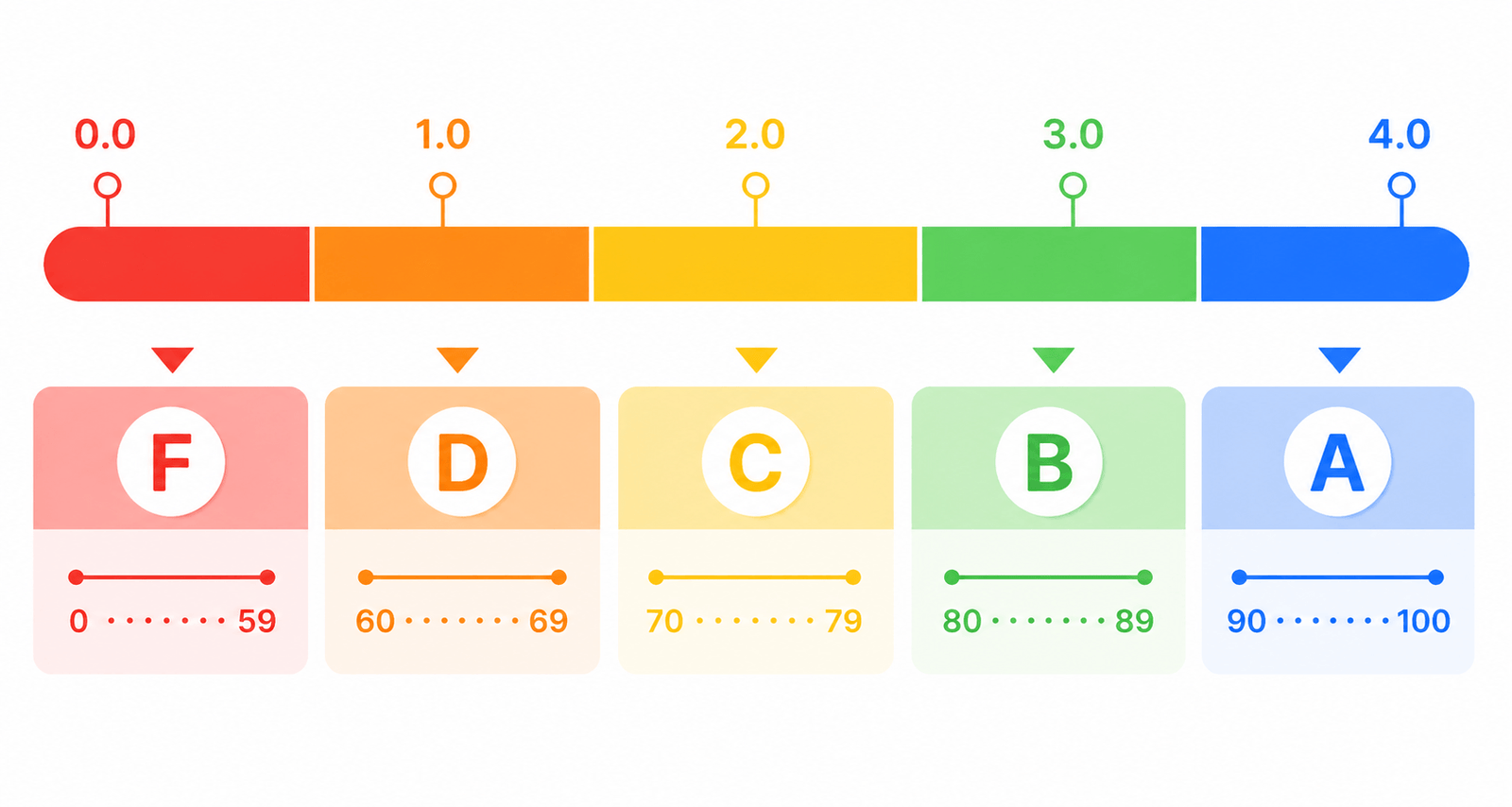
The HEC framework specifies that universities should use the 4.0 scale with the following grade distribution. Understanding this baseline is essential before examining how specific universities deviate from it:
| Letter Grade | Grade Points | Percentage Range | Classification |
|---|---|---|---|
| A+ / A | 4.0 | 85–100% | Outstanding / Excellent |
| A- | 3.7 | 80–84% | Very Good |
| B+ | 3.3 | 75–79% | Good |
| B | 3.0 | 70–74% | Above Average |
| B- | 2.7 | 65–69% | Average |
| C+ | 2.3 | 60–64% | Satisfactory |
| C | 2.0 | 55–59% | Acceptable |
| C- | 1.7 | 50–54% | Marginal Pass |
| D | 1.0 | 45–49% | Passing |
| F | 0.0 | Below 45% | Fail |
The HEC framework sets the minimum passing grade as D (45%) and the minimum CGPA for graduation as 2.0. These are floors — universities may set higher standards but cannot set lower ones without explicit HEC approval.
NUST — National University of Sciences and Technology
NUST is Pakistan's highest-ranked university by most international ranking systems and is the benchmark institution for engineering, computer science, and technology education in the country. Understanding NUST's grading system is important both for current NUST students and for those comparing qualifications across institutions.
NUST Grading Scale
NUST follows the HEC standard grading table closely, using absolute (marks-based) grading. The minimum passing mark at NUST is 50% across most courses, placing it at the more demanding end of the Pakistani university spectrum on passing requirements. Grade boundaries follow the HEC standard: 85%+ earns an A, 80–84% earns an A-, etc.
NUST Academic Honours
NUST has a two-tier academic recognition system that is among the most prestigious in Pakistan:
- Rector's Honor Roll: CGPA of 3.80 or above AND semester GPA of 3.80 or above in the relevant semester. Recipients receive formal recognition and the distinction appears on their transcript.
- Dean's Honor Roll: CGPA of 3.50 or above with no F grades in the relevant semester. Slightly less demanding than the Rector's List but still a significant academic achievement.
Both recognitions are noted on official transcripts and carry meaningful weight in graduate school applications and competitive employer shortlisting within Pakistan's engineering and technology sectors.
NUST Course Load and Credit System
Engineering programmes at NUST typically carry 130–140 total credit hours, with standard semesters running 16–20 credit hours. NUST engineering programmes are among the most credit-hour-intensive in Pakistan, which means your GPA calculation involves a larger number of courses with significant lab components. Lab courses at NUST carry 1–2 credit hours each and are graded separately from their corresponding theory courses.
Practical Advice for NUST Students
NUST's competitive cohort and rigorous assessment standards mean that GPA management requires proactive effort from Day 1. The 50% minimum pass standard (vs 45% at HEC baseline) means fewer courses that can be "rescued" with strong final exam performance after poor midterm results. Students who attend NUST and struggle with the pass threshold should seek academic support resources early — NUST provides tutoring and academic counselling services that are underutilised by students who wait until they are already failing.
NUST's Honours Roll thresholds (3.50+ for Dean's, 3.80+ for Rector's) are genuinely challenging given NUST's competitive environment. Students who consistently maintain Rector's Honor Roll standing are amongst the highest-performing engineering graduates in Pakistan and face minimal barriers in competitive national and international job markets.
LUMS — Lahore University of Management Sciences
LUMS occupies a unique position in Pakistan's higher education landscape — it is the country's most internationally oriented university and the institution most frequently compared favourably to elite institutions abroad. Its grading system reflects this orientation, with practices borrowed from elite North American and European business schools.
LUMS Relative (Curved) Grading System
The most distinctive feature of LUMS's grading system is the use of relative grading — also called curve-based grading or norm-referenced grading — in many of its courses, particularly at the Suleman Dawood School of Business (SDSB) and in several courses across the Mushtaq Ahmad Gurmani School of Humanities and Social Sciences.
Under relative grading, your letter grade is not determined solely by your raw percentage score against a fixed scale. Instead, the distribution of grades across the class is considered, and grades are assigned to maintain certain distributions — typically ensuring that a proportion of the class receives each grade range. This means that in a high-performing cohort, a student who scored 78% might receive a B (or even a B-) rather than the B+ they would receive under absolute grading, because many of their classmates also scored 75–82%. Conversely, in a struggling cohort, a student who scored 68% might receive a B because their score is significantly above the class mean.
The practical implication is that LUMS students cannot rely on the standard percentage-to-grade conversion table that applies at most other Pakistani universities. A 75% raw score does not automatically mean a B+ at LUMS — it might mean a B, a B+, or even an A-, depending on how the rest of the class performed on the same assessment.
Why LUMS Uses Relative Grading
The philosophical rationale for relative grading is that it prevents grade inflation (the tendency for average grades to rise over time even when average performance remains constant), ensures that grades convey meaningful information about relative performance, and maintains consistency across different cohort years. These are legitimate academic goals, and relative grading is used at top international universities including Harvard, Wharton, and most elite European business schools for exactly these reasons.
The limitation of relative grading — particularly from a Pakistani student's perspective — is that it makes grade prediction more difficult and reduces the transparency of the relationship between effort and outcome. A student who works harder than last year's cohort in the same class may receive the same grade, because their relative standing within the current cohort is unchanged. This can feel unfair but reflects a fundamentally different philosophy about what grades should measure.
LUMS Grading Scale
Despite the relative grading approach in many courses, LUMS uses the same 4.0 scale with the same grade point assignments as the HEC standard. The minimum passing grade is D (1.0), requiring a minimum percentage that depends on the class distribution rather than a fixed absolute threshold. The minimum graduation CGPA is 2.0 for most programmes and 2.5 for the BBA and MBA at SDSB.
LUMS Dean's List
The LUMS Dean's List recognises students who achieve a CGPA of 3.50 or above while enrolled in a full-time course load with no F or I (Incomplete) grades outstanding. LUMS Dean's List recognition is widely respected among Pakistan's most competitive employers, particularly in finance, consulting, and business.
Practical Advice for LUMS Students
At LUMS, the most important GPA management principle is understanding that your grade is partly determined by how you perform relative to your classmates — making class dynamics and cohort quality relevant in ways that absolute-grading universities do not require you to consider. Forming study groups that help the whole group understand material deeply is particularly valuable at LUMS, because raising general understanding levels across a group can produce better outcomes for all members in relative grading contexts.
For LUMS students tracking GPA: use our GPA Calculator with the grade you actually received (from your official results), not a conversion from your raw percentage. At LUMS, the letter grade on your marksheet is what matters — do not attempt to predict it from raw percentage using standard conversion tables.
FAST-NUCES — National University of Computer and Emerging Sciences
FAST-NUCES is Pakistan's leading computer science and technology university and the institution that produces the largest number of high-quality software engineers in the country. Its grading system has two important differences from the HEC standard that every FAST student must understand.
The 40% Minimum Pass Mark
While most Pakistani universities require a minimum of 45–50% to pass a course, FAST-NUCES sets its minimum passing mark at 40%. This means that students who score 40–44% in a course at FAST receive a D grade (1.0 grade points) and pass the course, whereas the same score at NUST or UAF would result in an F and failure. This lower passing threshold reflects FAST's philosophy that university courses should challenge students while still providing paths for students who demonstrate at least minimal competency to progress.
The D+ Grade
FAST-NUCES is one of very few Pakistani universities to include a D+ grade in its grading scale. D+ carries 1.3 grade points and corresponds to a raw score of 45–49%. This creates an intermediate level between D (1.0, earned at 40–44%) and C- (1.7, earned at 50–54%) that most other universities skip entirely. For GPA calculation purposes, D+ (1.3) is used wherever applicable — do not assume the standard table applies if you study at FAST.
FAST-NUCES Complete Grading Scale
| Letter Grade | Grade Points | Marks Range | Description |
|---|---|---|---|
| A | 4.0 | 85–100% | Excellent (no A+ distinction) |
| A- | 3.7 | 80–84% | Very Good |
| B+ | 3.3 | 75–79% | Good |
| B | 3.0 | 70–74% | Above Average |
| B- | 2.7 | 65–69% | Average |
| C+ | 2.3 | 60–64% | Satisfactory |
| C | 2.0 | 55–59% | Acceptable |
| C- | 1.7 | 50–54% | Marginal Pass |
| D+ | 1.3 | 45–49% | Passing (FAST-specific) |
| D | 1.0 | 40–44% | Minimum Pass |
| F | 0.0 | Below 40% | Fail |
FAST Dean's List
FAST's Dean's List is one of the most competitive academic recognitions in Pakistani technology education. Requirements: semester GPA of 3.80 or above, full-time course load (no reduced load), no F grade in any course that semester, and no pending Incomplete (I) grades from previous semesters. FAST Dean's List recognition appears on official transcripts and is highly regarded by Pakistan's technology employers.
FAST Course Repeat Policy
FAST's course repeat policy is notably student-friendly: the new grade fully replaces the old grade in CGPA calculations. The old grade remains visible on the transcript as a historical record, but it is removed from GPA calculations and substituted with the new grade. Students may repeat courses in which they received D+, D, or F, and may also repeat courses with higher grades to improve their GPA subject to seat availability. A course may typically be repeated a maximum of twice total.
Practical Advice for FAST Students
The D+ grade at FAST is worth being aware of strategically. At other universities, a score of 45–49% results in a D (1.0). At FAST, it results in a D+ (1.3) — a 0.3 point grade point improvement that translates to meaningfully higher GPA contribution on the same raw performance. This matters most in high-credit courses where borderline performance exists.
Use our dedicated FAST GPA Calculator which incorporates the D+ grade and FAST's specific grading boundaries — the generic calculator may produce different results for scores in the 40–49% range.
University of Agriculture Faisalabad (UAF)
UAF is one of Pakistan's largest universities by enrolment and the country's most important institution for agricultural sciences, food technology, veterinary medicine, and related disciplines. Its grading structure has several features shaped by the practical, lab-intensive nature of agricultural education.
UAF Grading Scale
UAF follows the HEC standard 4.0 scale closely, with a minimum passing mark of 50%. The grade boundaries are essentially identical to the HEC standard table shown above. One notable feature specific to UAF: lab courses are treated as entirely independent units in grading, with their own assessment structure, their own grade, and their own credit hours contributing separately to GPA calculations.
UAF's Lab-Heavy Programme Structure
Agricultural education at UAF is inherently practical. A typical UAF semester includes 2–3 theory courses (each 2–3 credit hours), 2–3 lab courses (each 1 credit hour), and 1–2 general education or elective courses. The lab courses are graded through weekly practical performance, lab reports, practical demonstrations, and a lab final examination — an assessment structure entirely separate from the corresponding theory course. A student can earn an A in the Agronomy Lab while struggling in Agronomy Theory, or vice versa.
This lab-theory separation creates strategic opportunities that many UAF students under-exploit. Lab performance is more predictable and controllable than theory examination performance: if you complete your lab work carefully, submit thorough lab reports, and engage seriously with practical demonstrations, you will consistently earn strong lab grades. With 3–5 labs per semester (each contributing 1 credit hour), consistent A and A- grades in labs contribute 3–5 quality points per semester beyond what theory performance alone would generate.
UAF Academic Standing
- Good Academic Standing: CGPA 2.0 or above
- Academic Probation: CGPA falls below 2.0 — one semester to recover
- Academic Dismissal: CGPA remains below 2.0 for two consecutive probationary semesters
- Distinction at Graduation: CGPA 3.5 or above
- High Distinction: CGPA 3.7 or above
Practical Advice for UAF Students
The most impactful single habit for UAF students is treating lab courses with the same seriousness as theory courses. Lab attendance is often strictly monitored and missed sessions frequently cannot be made up — a pattern of lab absences can cost you significant grade components that no amount of final exam performance can recover. Use our dedicated UAF GPA Calculator for accurate calculations incorporating the lab-heavy credit structure of UAF programmes.
University of the Punjab (PU)
The University of the Punjab, established in 1882, is Pakistan's oldest university and one of its largest. PU's transition from annual examinations to the semester-based GPA system — completed across most faculties in the 2010s — is ongoing for some professional programmes. Understanding PU's grading structure requires awareness of this ongoing transition.
PU Grading Scale
PU's majority of programmes now use the HEC-standard 4.0 scale with a 50% minimum passing mark and 2.0 minimum graduation CGPA. The grade boundaries follow the standard table. For any PU faculty or programme that may still operate on annual or hybrid examination structures, percentage-based assessment may still apply — consult your specific faculty's academic regulations.
PU Programme Diversity
PU's size and age mean it offers an exceptional range of programmes — from engineering and computer science to literature, history, philosophy, law, and religious studies. The credit structure and assessment approaches vary significantly across these disciplines. Science and engineering programmes at PU's Institute of Chemical Engineering and Technology or Department of Computer Science follow credit-hour-based semester structures closely aligned with HEC guidelines. Humanities and social science programmes may have different credit structures and assessment emphases.
Practical Advice for PU Students
PU's large class sizes (often significantly larger than at private universities) mean that individual faculty attention is more limited than at smaller institutions. Students who take initiative — attending office hours, seeking clarification early, forming strong peer study networks — consistently outperform those who remain passive in large lecture environments. Use our Punjab University GPA Calculator for accurate GPA calculations.
COMSATS University Islamabad (CUI)
COMSATS operates campuses in Islamabad, Lahore, Abbottabad, Sahiwal, Vehari, and Attock, making it one of the most geographically distributed universities in Pakistan. It is particularly strong in computer science, software engineering, and applied sciences.
COMSATS Grading System
COMSATS uses the HEC-standard 4.0 scale with absolute marks-based grading. The minimum passing mark is 50% and the minimum graduation CGPA is 2.0. COMSATS is notable for its relatively transparent and straightforward absolute grading system — your raw percentage score against the standard scale determines your grade with high predictability. Students who understand the grade boundaries and target 85%+ for A grades, 75–79% for B+, and so on will find COMSATS's assessment structure among the most predictable of any major Pakistani university.
COMSATS Dean's List
COMSATS recognises students who achieve a CGPA of 3.50 or above on the Dean's List. The Dean's List designation appears on official transcripts and is evaluated at the end of each academic year rather than each semester.
IBA Karachi — Institute of Business Administration
IBA Karachi, established in 1955 in affiliation with the University of Karachi, is Pakistan's most prestigious and oldest business school and one of Asia's pioneer management education institutions. Its grading system reflects both its elite positioning and its strong orientation toward international business education standards.
IBA's Relative Grading
Like LUMS, IBA uses relative grading in many of its courses, particularly at the undergraduate BBA and MBA levels. Your letter grade at IBA depends partly on class performance distribution, not only on your absolute marks. This creates the same strategic and analytical challenges for IBA students as described above for LUMS students — standard percentage-to-grade conversion tables do not apply, and grade prediction requires understanding class performance context.
IBA's Higher Minimum Graduation CGPA
IBA sets a minimum CGPA of 2.5 for graduation from its BBA and MBA programmes — 0.5 points higher than the HEC minimum of 2.0. This reflects IBA's commitment to maintaining higher academic standards consistent with its premium positioning. Students who fall below 2.5 CGPA at IBA face academic probation and must recover above the 2.5 threshold within one to two semesters.
IBA Dean's List
IBA's Dean's List requires a CGPA of 3.50 or above. Given the relative grading system and competitive cohort quality at IBA, this threshold is genuinely demanding — it represents top-quartile academic performance in an already highly selected student body.
UET Lahore — University of Engineering and Technology
UET Lahore, established in 1921, is Pakistan's oldest engineering university and historically one of its most respected. Its graduates dominate many of Pakistan's engineering institutions and include prominent figures in academia, public service, and industry.
UET Grading Scale
UET follows HEC guidelines with the 4.0 GPA scale. The minimum passing mark varies by course type: theory courses typically require 40–45% and lab/practical courses have their own passing thresholds. UET's engineering programmes carry significant lab, workshop, and project components that contribute separately to GPA calculations — the credit structure is among the most lab-intensive of any major Pakistani university.
UET Programme Structure
UET's 4-year engineering programmes typically carry 130–145 total credit hours, with substantial laboratory credit hours embedded throughout the programme. Laboratory courses at UET often carry 1–3 credit hours, significantly more than the standard 1-credit labs at most other universities. This higher lab credit weight means that GPA strategies at UET should place even greater emphasis on lab performance than at institutions with smaller lab credit allocations.
Comprehensive University Comparison Table
| University | GPA Scale | Min Pass | Min Grad CGPA | Grading Type | Dean's List | Notable Feature |
|---|---|---|---|---|---|---|
| NUST | 4.0 | 50% | 2.0 | Absolute | CGPA 3.50+ | Rector's List at 3.80+ |
| LUMS | 4.0 | ~50%* | 2.0–2.5 | Relative | CGPA 3.50+ | Curved grading |
| FAST-NUCES | 4.0 | 40% | 2.0 | Absolute | Sem GPA 3.80+ | D+ grade (1.3 pts) |
| UAF | 4.0 | 50% | 2.0 | Absolute | CGPA 3.50+ | Lab-intensive |
| Punjab Uni | 4.0 | 50% | 2.0 | Absolute | CGPA 3.50+ | Pakistan's oldest |
| COMSATS | 4.0 | 50% | 2.0 | Absolute | CGPA 3.50+ | Multi-campus |
| IBA Karachi | 4.0 | ~50%* | 2.5 | Relative | CGPA 3.50+ | Higher min CGPA |
| UET Lahore | 4.0 | 40–45% | 2.0 | Absolute | CGPA 3.50+ | Heavy lab credits |
| QAU Islamabad | 4.0 | 45% | 2.0 | Absolute | CGPA 3.50+ | Research focus |
*LUMS and IBA use relative grading; "minimum pass" depends on class distribution.
Absolute vs Relative Grading — A Detailed Comparison
The difference between absolute and relative grading is one of the most significant structural differences between Pakistani universities, and it has implications beyond just how you calculate your GPA.
Absolute Grading — The Majority System
Under absolute grading (used at NUST, UAF, COMSATS, PU, UET, and most other Pakistani universities), your letter grade is determined by your raw percentage score against a fixed scale. Score 85%+ and you earn an A. Score 75–79% and you earn a B+. This is the same regardless of how your classmates performed. Absolute grading is transparent, predictable, and effort-rewarding: if you achieve 85%, you earn an A whether you are the top student in the class or the 50th.
Relative Grading — The Elite Institution System
Under relative grading (used at LUMS, IBA, and partially at some other institutions), your letter grade reflects your performance relative to your classmates. The exact mechanisms vary by course and instructor — some use strict bell curves; others use more flexible distributions — but the common feature is that the class performance distribution influences grade assignments. This can work in your favour in difficult courses where everyone struggles (your B effort might earn a B+ or A- because you performed above the struggling median), and against you in courses where you face an exceptionally high-performing cohort (your objectively strong performance might earn a B rather than the A it would warrant under absolute grading).
How GPA Comparisons Work Across Universities
A frequently asked question among Pakistani students and employers is whether a 3.5 CGPA from NUST is "equivalent" to a 3.5 CGPA from a less competitive institution. The honest answer is nuanced: the number is the same on a 4.0 scale, but the academic effort and cohort quality required to achieve it differ between institutions.
Pakistani employers are generally aware of this reality. A 3.5 CGPA from NUST, LUMS, or FAST typically receives higher implicit weighting than the same number from a less selective institution, because employers understand that the competitive environment and rigorous assessment at these universities makes the same GPA harder to achieve. This is why "which university" matters alongside "what CGPA" for many competitive employment opportunities.
For formal credential comparisons — particularly for international applications — the university's global ranking and recognition matter as much as the CGPA number. Many international graduate programmes evaluate Pakistani applicants' academic credentials through official evaluation services (like WES for North American applications) rather than accepting GPA numbers at face value.
Frequently Asked Questions
Q: Can I transfer my CGPA from one Pakistani university to another?
Credit transfer between Pakistani universities is possible but governed by specific HEC and institutional policies. Your CGPA from the sending institution does not automatically transfer — receiving universities typically evaluate transferred credits individually and may or may not include the grades in CGPA calculations. Contact the admissions or registrar office at your intended institution for specific transfer credit policies before making decisions based on assumptions.
Q: If I took courses at multiple universities, whose grading scale applies?
For courses completed at your home institution, your home institution's grading scale applies. For transfer credits, the receiving institution's policy on grade conversion applies — often the grade from the sending institution is listed with a note and may or may not be converted to the receiving institution's grade points. For exchange programme courses, specific articulation agreements govern how grades are recorded.
Q: My CGPA from a less well-known university is 3.7. Will employers treat it the same as 3.7 from NUST?
Formally, both represent the same position on the 4.0 scale. In practice, many competitive Pakistani employers do distinguish between institutions, using university reputation as a proxy for academic rigour. A 3.7 from NUST, LUMS, or FAST is likely to receive more weight at highly selective employers than a 3.7 from a less recognised institution. However, work experience, skills demonstrations, and interview performance can compensate for institutional prestige differences, particularly after a year or two in the workforce.
Conclusion
Pakistan's top universities all use the 4.0 GPA scale, but meaningful variations in minimum passing marks, grading philosophy (absolute vs relative), Dean's List thresholds, minimum graduation CGPAs, and lab credit structures create differences that matter for students, employers, and institutions comparing credentials. Understanding your specific university's policies — not just the generic HEC standard — is essential for accurate GPA calculation, appropriate academic goal-setting, and strategic planning.
For GPA calculations, use the appropriate tool for your institution:
- UAF GPA Calculator
- FAST University GPA Calculator
- Punjab University GPA Calculator
- General GPA Calculator — for NUST, COMSATS, and all standard 4.0-scale universities
Questions about your specific university's grading system? Email us at contact@techpot.site.
New and Emerging Universities — What to Expect from Their Grading
Several newer Pakistani universities — established in the 2010s and 2020s — are gaining recognition but may not have the same depth of publicly available grading policy information as established institutions. Riphah International University, Air University, Bahria University, Capital University of Science and Technology (CUST), and Iqra University are among the newer institutions with growing student populations. These universities uniformly use the 4.0 GPA scale (HEC requirement for all recognised institutions) and generally follow the HEC standard grading framework closely. Their specific Dean's List thresholds and minimum passing marks vary by faculty and programme — verify directly with your department if you attend any of these institutions rather than assuming generic HEC standards apply in all details.
How Grading System Differences Affect Cross-University Comparison
When Pakistani employers or graduate school admissions committees compare candidates from different universities, they face the challenge that a 3.5 CGPA from a university with relative grading (LUMS, IBA) is genuinely different from a 3.5 CGPA at a university with absolute grading (NUST, COMSATS). At LUMS, earning a 3.5 means performing in the upper portion of your cohort in multiple semesters — the grade itself encodes relative standing. At NUST, earning a 3.5 means consistently scoring in the 75–85% range on absolute assessments. These are both meritorious achievements, but they are not identical. Informed Pakistani employers — particularly those who recruit from multiple universities — are generally aware of this distinction, and it is one reason why interview performance and demonstrated skills remain important differentiators alongside CGPA for competitive roles.
Postgraduate Admission Requirements — What Each University Actually Accepts
Beyond the official minimum CGPAs stated in university admission criteria, there is a practical competitive reality for Pakistani MS and MPhil programme admissions. The official minimum is the legal floor for application eligibility. The actual CGPA of admitted students typically runs considerably higher, particularly in competitive programmes. NUST MS in Computer Science: officially 2.0 minimum, competitive applicants typically 3.0+. LUMS MBA: officially 2.5 minimum, typical admitted cohort 3.3+. QAU MS in Chemistry: officially 2.5, competitive range 3.0+. UAF MS in Agriculture: officially 2.5, practical range 2.8+. Understanding the difference between the stated minimum and the competitive standard is essential for graduate school planning — applying with the stated minimum is technically eligible but practically unlikely to succeed at competitive programmes.