Home › Blog › GPA vs Percentage
Comparison GuideGPA vs Percentage in Pakistan — Complete Comparison Guide 2025
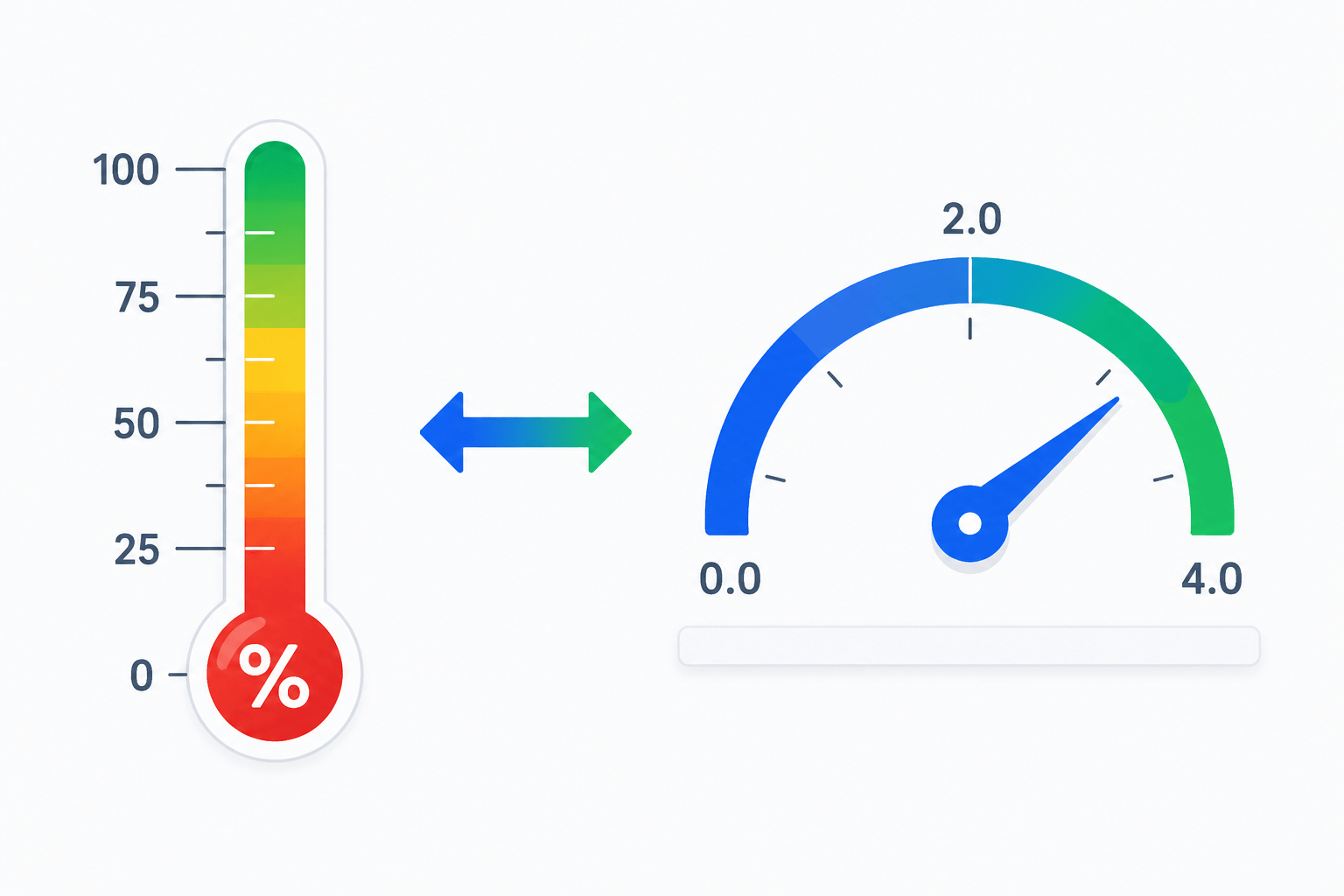
Pakistan's academic landscape exists in a period of dual measurement systems. Universities have largely transitioned to GPA-based semester assessment, but government recruitment, civil service examinations, many employer application forms, and a significant portion of the administrative infrastructure still operate in percentage terms. Pakistani students routinely encounter situations where they must present their academic credentials in one format when their official records are in the other — and the conversion between these formats is not always as straightforward as a simple formula suggests.
This comprehensive guide covers every aspect of the GPA-percentage relationship that Pakistani students need to navigate successfully. We begin with the historical context of why Pakistan has both systems operating simultaneously, explain the conceptual differences between the two measurement approaches, provide the complete conversion formulas and reference tables, detail exactly when each format is required in different professional and academic contexts, examine the practical limitations of conversions, and address the most common questions students encounter when dealing with both systems. By the end, you will have complete fluency in both systems and the confidence to present your academic credentials appropriately in any context.
Why Pakistan Has Both Systems — Historical Context
To understand why Pakistani students face the dual-system challenge, it helps to understand how the two measurement systems developed in parallel rather than replacing each other cleanly.
The percentage system in Pakistan has roots in British colonial educational practice, which standardised annual examination results as percentages of total marks available. When Pakistan was established in 1947, it inherited this educational infrastructure, and the percentage system became deeply embedded in government administrative practice, professional licensing, public employment criteria, and social understanding of academic achievement. "First Division" (60%+), "Second Division" (45–59%), and "Third Division" (33–44%) became culturally understood markers of academic performance that required no specialist knowledge to interpret.
The GPA system was introduced by the Higher Education Commission in the early 2000s as part of a broader modernisation of higher education. The rationale was compelling: Pakistan's degree system needed to align with internationally recognised standards, the annual examination model produced too little feedback to students during their degree, and the credit-hour weighted average system provided a more nuanced and internationally comparable measure of academic performance. The transition from percentage to GPA at universities was largely successful by the 2010s.
However, the rest of Pakistan's institutional infrastructure — government employment, civil service, professional licensing, older employer application systems — did not transition simultaneously. The result is the current dual-system reality: Pakistani university graduates hold CGPA-based credentials but frequently need to present them in percentage terms to government and administrative systems that have not yet adopted GPA-based evaluation. This situation is likely to persist for many years, making fluency in both systems a practical necessity for Pakistani graduates.
The Conceptual Difference — What Each System Actually Measures
Before examining conversions, it is important to understand the conceptual differences between GPA and percentage, because these differences explain both why the conversion is sometimes necessary and why it is always an approximation rather than an exact equivalence.
What Percentage Measures
A percentage score measures your marks obtained as a proportion of the maximum marks possible. If you scored 73 out of 100 in an examination, your percentage for that examination is 73%. If you scored 730 out of 1000 total marks across all courses in a year, your annual percentage is 73%. Percentage is a direct, transparent ratio — there is no weighting involved beyond the marks allocation structure of the examination itself, and the number has direct intuitive meaning: 73% means you earned 73 out of every 100 possible marks.
The percentage system does not inherently account for the relative academic importance of different subjects unless the examination carries different total marks for different subjects (which is sometimes the case but not standardised). In the traditional annual Pakistani examination model, if every subject carries 100 marks, then every subject contributes equally to your final percentage — a subject you found trivially easy counts the same as the most intellectually demanding course in your programme.
What GPA Measures
GPA measures your average grade point achievement across courses, weighted by the credit hours each course carries. Unlike percentage, GPA does not directly reflect raw marks — it converts mark ranges into categorical grade points (A = 4.0, B+ = 3.3, etc.) and then computes a weighted average. A student who scored 86% in every course would receive exactly the same GPA (4.0) as one who scored 94% in every course, because both earn A grades above 85%. The GPA system effectively compresses the upper range of marks into a common category.
GPA accounts for course importance through credit hours — a course carrying 4 credit hours contributes four times as much to your GPA as one carrying 1 credit hour, regardless of the marks structure. This makes GPA a more sophisticated measure of overall academic performance than raw percentage in cases where courses have very different levels of academic importance or difficulty.
The Precision Difference
One important practical difference between the two systems is precision. A percentage is a continuous measure — you can score 73%, 73.5%, 73.8% — with infinite gradations between 0 and 100. GPA is a step function — you earn either an A (4.0) or an A- (3.7), with nothing in between, regardless of whether you scored 85% or 99%. This means GPA is inherently less precise in capturing the gradations within a letter grade band, but this "imprecision" is intentional — the GPA system treats 85% and 99% as equally excellent for the purposes of academic recognition.
When converting from GPA to percentage, you are therefore converting from a step-function measurement to a continuous one — an operation that is inherently approximate. A 3.5 CGPA does not mean you literally scored 87.5% in everything; it means your weighted average of letter grades corresponds mathematically to that position on the GPA scale, which converts to approximately 87.5%.
The Complete Conversion Formulas
The standard conversion formulas used in Pakistan are endorsed by the HEC and accepted by most administrative and professional bodies that require percentage conversion of GPA credentials.
GPA to Percentage
Percentage = (CGPA ÷ 4.0) × 100
This is the most universally accepted formula. It linearly maps the 4.0 GPA scale to the 0–100 percentage scale. A 4.0 GPA converts to 100%, a 2.0 GPA converts to 50%, and so on. This formula is also sometimes expressed as:
Percentage = CGPA × 25
Both formulas produce identical results. The multiplication-by-25 version is convenient for mental calculation: a 3.5 CGPA = 3.5 × 25 = 87.5%; a 3.0 CGPA = 3.0 × 25 = 75%.
Percentage to GPA
GPA = (Percentage ÷ 100) × 4.0 OR GPA = Percentage ÷ 25
Again, both formulas produce identical results. For quick mental calculation: 75% ÷ 25 = 3.0 GPA; 85% ÷ 25 = 3.4 GPA; 90% ÷ 25 = 3.6 GPA.
Complete GPA to Percentage Reference Table
| CGPA (4.0 Scale) | Percentage Equivalent | Letter Grade | Classification | Career Implication |
|---|---|---|---|---|
| 4.00 | 100.0% | A+/A | Outstanding | Top of class, scholarships |
| 3.90 | 97.5% | A+/A | Outstanding | Highly competitive |
| 3.80 | 95.0% | A+/A | Outstanding | Rector's Honor Roll |
| 3.70 | 92.5% | A- | Excellent | Distinction range |
| 3.60 | 90.0% | A- | Excellent | Highly competitive |
| 3.50 | 87.5% | A-/B+ | Very Good | Dean's List eligible |
| 3.40 | 85.0% | B+ | Good | Strong applicant |
| 3.30 | 82.5% | B+ | Good | Good standing |
| 3.20 | 80.0% | B+/B | Good | Most jobs accessible |
| 3.10 | 77.5% | B | Above Average | Meets most requirements |
| 3.00 | 75.0% | B | Above Average | Industry benchmark |
| 2.90 | 72.5% | B | Above Average | Above minimum |
| 2.80 | 70.0% | B- | Average | Meets basic requirements |
| 2.70 | 67.5% | B- | Average | Some limitations |
| 2.60 | 65.0% | B- | Average | Limited options |
| 2.50 | 62.5% | C+ | Satisfactory | Basic eligibility met |
| 2.40 | 60.0% | C+ | Satisfactory | Below many HR filters |
| 2.20 | 55.0% | C | Acceptable | Significant limitations |
| 2.00 | 50.0% | C | Pass | Minimum graduation |
| 1.80 | 45.0% | D | Marginal | Academic risk zone |
| 1.50 | 37.5% | D | Marginal | Academic probation risk |
Complete Percentage to GPA Reference Table
| Percentage Range | GPA Equivalent | Letter Grade | HEC Standard |
|---|---|---|---|
| 90–100% | 3.60–4.00 | A+/A | Outstanding |
| 85–89% | 3.40–3.56 | A | Excellent |
| 80–84% | 3.20–3.36 | A- | Very Good |
| 75–79% | 3.00–3.16 | B+ | Good |
| 70–74% | 2.80–2.96 | B | Above Average |
| 65–69% | 2.60–2.76 | B- | Average |
| 60–64% | 2.40–2.56 | C+ | Satisfactory |
| 55–59% | 2.20–2.36 | C | Acceptable |
| 50–54% | 2.00–2.16 | C- | Marginal Pass |
| 45–49% | 1.80–1.96 | D | Passing |
| Below 45% | Below 1.80 | F | Fail |
When to Use GPA in Pakistan — Context Guide
Private Sector Corporate Employment
Most modern Pakistani corporations — particularly multinationals, financial institutions, and technology companies — request CGPA in their application systems. Their online application portals typically have a field for "CGPA" or "GPA out of 4.0" that expects your cumulative GPA number directly. When an employer's form says "GPA," enter your CGPA (the cumulative number from your degree). Do not attempt to convert to percentage and then back to GPA — just enter the number from your official transcript.
Employers in this category include: Unilever Pakistan, Procter and Gamble Pakistan, Shell Pakistan, Standard Chartered, HBL, MCB, PTCL, Engro Corporation, Systems Limited, and most major multinationals operating in Pakistan.
International University Applications
When applying to graduate programmes abroad, always use your CGPA. International university application systems are designed around the 4.0 GPA scale used globally. Most graduate school applications (including the Common Application, UCAS, and individual university portals) ask for your GPA on a 4.0 scale — enter your CGPA directly. For institutions that use different scales (Germany's 1–5, UK's classification system), you may need to provide the percentage equivalent alongside your CGPA, but the GPA is your primary credential.
International Scholarships
Major international scholarship programmes — Fulbright, Chevening, DAAD, Erasmus+, Australian Awards, Commonwealth Scholarships — all request GPA or CGPA in their application materials. These programmes are familiar with Pakistani academic credentials and expect the 4.0 scale CGPA from university graduates. Do not pre-convert to percentage for these applications; use your official CGPA.
Pakistani MS and PhD Admissions
Graduate programme admissions at Pakistani universities request CGPA for evaluating undergraduate applications. NUST, LUMS, COMSATS, QAU, and all major Pakistani universities state their minimum admission CGPA in 4.0 scale terms (typically 2.0–3.0 minimum, with competitive programmes in practice admitting 2.8–3.3+). Enter your CGPA directly on these application forms.
When to Use Percentage in Pakistan — Context Guide
Federal Government Employment (FPSC)
The Federal Public Service Commission (FPSC) conducts examinations and manages recruitment for Pakistan's federal civil service. FPSC application forms request educational qualifications in percentage or division terms (First Division, Second Division, etc.). When filling FPSC forms, convert your CGPA to percentage using the standard formula (CGPA × 25) and enter the resulting percentage. For reference: 3.0 CGPA = 75% (First Division); 2.5 CGPA = 62.5% (Second Division); 2.0 CGPA = 50% (Second Division).
CSS and PMS Competitive Examinations
The Central Superior Services (CSS) examination — administered by FPSC — and Provincial Management Service (PMS) examinations require a minimum second-class degree for eligibility. Second-class in the traditional Pakistani division system corresponds to approximately 45–59.9% marks. Since most CSS/PMS applicants now hold GPA-based degrees, the conversion formula is necessary: a CGPA of 2.0 converts to exactly 50% (solidly second division); a CGPA of 1.8 converts to 45% (minimum second division); a CGPA of 2.4 converts to 60% (borderline first/second division).
Provincial Public Service Commissions
Punjab, Sindh, KPK, and Balochistan Public Service Commissions conduct provincial civil service recruitment examinations. Like FPSC, these bodies use division-based or percentage-based eligibility criteria. The same conversion formula applies: when provincial PSC forms request percentage, multiply your CGPA by 25.
Government Healthcare, Teaching, and Professional Jobs
Government healthcare institutions, provincial school and college teaching positions, and various government professional roles often advertise with percentage-based minimum qualifications (e.g., "minimum 50% marks in relevant degree"). For these positions, convert your CGPA to percentage using the standard formula and present the converted percentage alongside your official transcript showing your CGPA.
Bank of Punjab, BISP, and Government Enterprises
Some government-controlled enterprises and development organisations in Pakistan use percentage-based eligibility in their job advertisements even when they use sophisticated online application systems. When in doubt, check whether the application form has a "CGPA" field or a "Percentage" field — fill whichever is present, using the conversion if necessary.
HEC Need-Based and Merit Scholarships
HEC's various scholarship programmes — need-based scholarships, merit scholarships, and some international scholarship facilitating programmes — use CGPA-based eligibility criteria in their documentation, but some administrative forms for these programmes still use percentage fields. When filling scholarship applications, check whether the eligibility criterion is stated in CGPA or percentage terms, and present your credentials in the matching format.
The Conversion Limitation — Why It Is Always an Approximation
The most important caveat about GPA-to-percentage conversion is this: the conversion is always an approximation, never an exact equivalence. This is not a flaw in the formula — it is an inherent property of converting between two different measurement systems with different structures.
The Compression Problem
The GPA system compresses the upper range of percentage performance into a single letter grade. Under the standard HEC grading scale, any percentage from 85% to 100% earns an A (4.0). This means that a student who averaged 86% across all courses and a student who averaged 97% across all courses would have identical GPA of 4.0. Converting both to percentage using the formula CGPA × 25 gives 100% for both — which accurately represents their equal GPA but does not reflect the fact that one student had genuinely higher raw marks than the other.
This compression is intentional in the GPA system's design — it treats both students as achieving the maximum grade standard, which is academically appropriate. But it means that percentage conversions from GPA are not "true" percentages in the sense of raw marks obtained; they are percentage equivalents of GPA standing.
The Grade Band Averaging Problem
A CGPA of 3.5 converts to 87.5% using the formula. But 3.5 does not mean the student scored exactly 87.5% in every course. Their individual course marks could range from 80% (A- boundary, which rounds to 3.7 in GPA) to 100% (solid A at 4.0), with the weighted average of grade points producing 3.5. Some courses might have been in the A range (85%+), others in the B+ range (75–79%), and the weighted average of these different grade point values happens to equal 3.5. The 87.5% conversion represents an equivalent position on the percentage scale, not the actual marks obtained.
Practical Implications of the Approximation
For most practical purposes in Pakistan — filling government forms, applying for scholarships, stating qualifications to employers who use percentage-based criteria — the approximation is perfectly adequate. The formula is widely accepted and administratively recognised. Problems only arise if you treat the converted percentage as if it were your actual exam percentage, or if you try to use percentage conversions in contexts where your GPA-based official transcript will be examined alongside the claimed percentage.
Best practice: when presenting credentials converted from GPA to percentage, clearly state "approximately" or "equivalent to" in your notation: "CGPA 3.52 / 4.0 (approximately 88%)" or "GPA equivalent: ~88%." This transparency prevents any suggestion of misrepresentation while communicating your academic standing effectively in percentage terms.
Percentage-Based Degree Classifications and Their GPA Equivalents
Pakistan's older administrative systems use division-based degree classifications inherited from the British educational tradition. Understanding the mapping between these classifications and the GPA scale is important for navigating government and administrative requirements.
| Pakistani Division | Percentage Range | GPA Equivalent | HEC Classification |
|---|---|---|---|
| First Division with Distinction | 80%+ | 3.2+ | Very Good to Excellent |
| First Division | 60–79% | 2.4–3.16 | Satisfactory to Good |
| Second Division | 45–59% | 1.8–2.36 | Passing to Acceptable |
| Third Division | 33–44% | 1.32–1.76 | Below minimum (at most unis) |
| Fail | Below 33% | Below 1.32 | Fail |
Note that Third Division (33–44%) falls entirely within what most Pakistani GPA-based universities would consider the fail range (F grade below 45%) or extremely marginal performance. The division system's pass threshold of 33% is lower than the 45–50% minimum pass at most GPA-based universities, reflecting the historical differences between examination systems.
How Employers Interpret GPA vs Percentage
Understanding how different Pakistani employers think about GPA and percentage helps you present your credentials most effectively.
Modern Corporate Employers
Multinational corporations, large private sector companies, and technology firms operating in Pakistan are fully conversant with GPA-based credentials. Their HR systems are designed for GPA input, their assessment benchmarks are in GPA terms (minimum 3.0 CGPA for screening, preference for 3.5+ for competitive programmes), and their recruiters understand the 4.0 scale intuitively. These employers do not need you to convert your credentials to percentage — in fact, presenting a converted percentage when they expect a CGPA may cause confusion. Use your CGPA directly.
Traditional Government and Semi-Government Employers
Government departments, public sector enterprises, and semi-government organisations (particularly those established before the GPA era) often use percentage or division-based eligibility criteria. For these employers, converting your CGPA to percentage is necessary and expected. The formula CGPA × 25 provides a recognised, HEC-endorsed conversion that is widely accepted for administrative purposes.
Small and Medium Private Enterprises
Smaller Pakistani private companies span the spectrum from highly sophisticated (using GPA-based evaluation) to quite traditional (using percentage or division terms). When you encounter an SME employer whose application form uses percentage fields, use the standard conversion. When their form uses CGPA fields, use your CGPA directly. When it is ambiguous, use your CGPA and offer the percentage equivalent parenthetically.
International GPA to Percentage Conversion — Different Countries
When Pakistani graduates seek opportunities in countries that use neither the 4.0 GPA scale nor the percentage system, additional conversion steps may be required. Here are the most common international academic credential systems and their approximate relationship to Pakistani CGPAs:
| Country / System | Scale | Pakistani 3.5 CGPA ≈ | Pakistani 3.0 CGPA ≈ |
|---|---|---|---|
| USA (4.0 Scale) | 0.0–4.0 | 3.5 / 4.0 | 3.0 / 4.0 |
| UK (Honours Classes) | Third to First Class | 2:1 (Upper Second) | 2:2 (Lower Second) |
| Germany (1–5 Scale) | 1 (best) to 5 (fail) | 2.0 (Gut) | 2.5–3.0 |
| Australia (GPA) | 0–7 Scale | 5.5–6.0 | 4.5–5.0 |
| Canada (4.0 Scale) | 0.0–4.0 | 3.5 / 4.0 | 3.0 / 4.0 |
| UAE / Gulf (GPA) | 0.0–4.0 or 4.0–5.0 | 3.5 / 4.0 | 3.0 / 4.0 |
Note that international conversions are approximate and many universities use official evaluation services (WES, ICAS, NARIC/ENIC) for formal credential assessment. These services provide official equivalency opinions that are more reliable than informal conversion calculations for formal admissions and immigration purposes.
Frequently Asked Questions
Q: My CSS form asks for percentage in my bachelor's degree. What do I enter?
Convert your CGPA using the formula: Percentage = CGPA × 25. For example, if your CGPA is 3.20, enter 80%. Round to one decimal place if needed. Make sure your official transcript and degree certificate are available to verify this figure if requested. Many CSS candidates also attach a note explaining that their degree is GPA-based and the percentage is calculated using the HEC-endorsed conversion formula.
Q: My CGPA is 2.8. Is that First Division or Second Division for government purposes?
CGPA 2.8 converts to 70% (2.8 × 25 = 70). In the traditional Pakistani division system, 70% falls in the First Division range (60–79%). So a 2.8 CGPA would be classified as a First Division degree for government purposes that still use division-based criteria. For clarity: 2.4 CGPA (60%) is the boundary between First and Second Division; below 2.4 CGPA (below 60%) falls in Second Division.
Q: A scholarship requires 70% marks minimum. My CGPA is 2.82. Do I qualify?
Yes. 2.82 × 25 = 70.5%, which meets the 70% minimum. You should present your CGPA (2.82) as your primary credential and note the percentage equivalent (approximately 70.5%) alongside it. Include your official transcript showing the CGPA so the scholarship committee can verify the credential directly.
Q: Is there a standard reference that Pakistani institutions use for the GPA-to-percentage conversion formula?
The HEC endorses the CGPA × 25 / (CGPA ÷ 4) × 100 formula as the standard conversion. This formula appears in HEC documentation on degree equivalency and is accepted by FPSC, provincial PSCs, and most administrative bodies in Pakistan. When submitting formal applications, you can reference "HEC standard conversion formula: CGPA × 25" if asked for the basis of your percentage calculation.
Q: Can I improve my "percentage" by improving my CGPA?
Yes — since the percentage conversion is directly proportional to CGPA (Percentage = CGPA × 25), any improvement in your CGPA mathematically improves your percentage equivalent. A 0.1 CGPA improvement corresponds to a 2.5 percentage point improvement. Improving from 2.8 to 3.0 CGPA = improving from 70% to 75% equivalent — crossing from a strong First Division into a more competitive First Division range. Use our CGPA Calculator to track how grade improvements affect both your CGPA and its percentage equivalent.
Conclusion
The GPA-percentage conversion challenge is a practical reality of Pakistani academic life that every university graduate will encounter multiple times. Understanding both systems thoroughly — what each measures, how they relate mathematically, and when each is required — transforms a potentially confusing credential presentation challenge into a straightforward task.
The core rules to remember are simple: use your CGPA for modern corporate employers, international universities, and Pakistani graduate school applications; convert using the formula (CGPA × 25) for government employment, civil service examinations, and administrative bodies that use percentage or division criteria; and always note that the percentage is an equivalent conversion when presenting it alongside your official GPA-based credentials.
Use our free conversion tools for instant calculations: GPA to Percentage Converter and Percentage to GPA Converter.
Questions? Email us at contact@techpot.site.
The Historical Context — Why Both Systems Coexist in Pakistan
Pakistan's dual-measurement reality — universities using GPA while government uses percentage — is not an accident or an oversight. It reflects a deliberate but incomplete modernisation of the educational system. When HEC adopted the GPA framework for universities in the early 2000s, it was a forward-looking policy decision aligned with international standards. But government administrative systems, civil service recruitment rules, and legal frameworks for professional licensing had been built over decades around percentage-based criteria and could not be updated simultaneously. The result is the current dual-system landscape that Pakistani graduates must navigate.
There is no near-term resolution in sight. The FPSC, provincial PSCs, and professional licensing bodies would need coordinated legislative and administrative reform to transition their eligibility criteria from percentage to GPA terms — a process that would take years and face institutional resistance. Pakistani students graduating in the next decade should plan to maintain fluency in both systems throughout their careers, not expect the conversion challenge to resolve itself.
Percentage Division System vs GPA — A Quick Conversion Reference
Pakistan's older administrative systems use a division-based classification that many students from the GPA era find confusing. Here is the complete mapping between GPA, percentage equivalent, and the traditional division system:
| CGPA | % Equivalent | Division (Traditional) | Practical Context |
|---|---|---|---|
| 3.5–4.0 | 87.5–100% | First Division with Distinction | Most competitive opportunities |
| 2.4–3.49 | 60–87.4% | First Division | Standard corporate eligibility |
| 1.8–2.39 | 45–59.9% | Second Division | Government minimum eligibility |
| Below 1.8 | Below 45% | Third Division or Fail | Limited formal opportunities |
For CSS and PMS applications: "minimum second class / second division" corresponds to CGPA 1.8 at the lower boundary (45% equivalent), but the competitive reality is that very few CSS qualifiers have CGPAs below 2.5 — the minimum is a legal floor, not a competitive benchmark.
How to Present Your GPA When No Conversion Field Exists
Some older Pakistani application forms — particularly paper-based government forms and legacy online portals — have only a single "marks" or "percentage" field with no CGPA option. Best practice in these situations: enter your percentage equivalent (CGPA × 25) in the marks field, and attach a supplementary note (if the application permits attachments) explaining that your degree uses a 4.0 GPA system and the percentage entered is the standard HEC-endorsed equivalent. If you are attending an interview or submitting a physical application, bring your official transcript showing your CGPA so the evaluating body can verify your credential directly. Transparency about the calculation method, combined with the official transcript, eliminates any possibility of credential misrepresentation concerns.
Frequently Asked Questions — GPA vs Percentage (Extended)
Q: My university result card shows both GPA and percentage. Which is official?
Both figures on your official result card are equally official — your university has calculated both and certified both. The GPA is calculated using the weighted average formula from your letter grades and credit hours. The percentage shown is typically computed using the standard formula (CGPA × 25) and is printed for administrative convenience. Present whichever format the specific application or institution requires.
Q: My matric was 90%, intermediate was 85%, but my bachelor's CGPA is 2.8. Will employers judge me for the drop?
The transition from 85–90% at intermediate to 2.8 CGPA (70% equivalent) at university is common and not necessarily alarming to informed Pakistani employers. University is genuinely more demanding than intermediate board examinations, and the two systems are not directly comparable. What employers care about is your final bachelor's CGPA — not the comparison to intermediate scores. Present your credentials straightforwardly without pre-emptive apology.
Q: A job requires "GPA 2.5 minimum OR 62% minimum." I have 2.45 CGPA. Am I eligible?
2.45 CGPA converts to 61.25% — technically below both thresholds. However, this is an extremely marginal shortfall. Apply anyway and address the GPA directly in your application materials, explaining any compensating strengths or improving trend. The worst outcome is rejection you were already facing; the best is a chance to make your case to a recruiter who recognises the marginal difference.